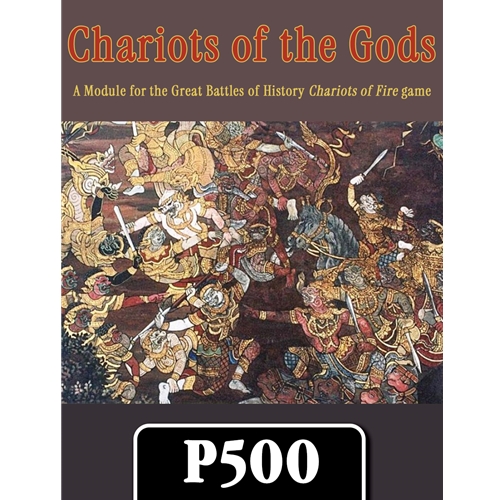
Chariots of the Gods (CG) simulates tactical-level combat in the period of India’s ancient Vedic era. Covering a period extending from roughly 1700 to 800 BCE, the age of Vedic India was one of sweeping battles between great kingdoms for supremacy over northern India. This was the age of the chariot-knight, whose prowess with the compound bow from his speeding war-car inspired legends. Often the bravery of the charioteer, whose skill in commanding the vehicle safely through the chaos and danger of the ancient battlefield was no less legendary.
Given the heroic nature of the age, the Chariot of Fire Heroes rules have been expanded to portray the fighting styles in the Vedic poems. All scenarios feature Heros and Heroic Challenges. Rather than Heroes engaging in personal combat only on foot, the Vedic heroes duel each other from a moving chariot wielding their bows. The Hero counter represents not only the Hero, but his Charioteer, and his Chattra (banner) all of which may be hit by his opponent.
CG introduces three new unit types:
- Javelin Infantry: Javelin/light spear armed troops with no armor and no missile capability, fighting in loose formations. These units provide the shock power for most of the tribes.
- Dismounted Chariots: Noted on the reverse side of the CH-2 counter, these are the knights on foot rather than in their chariots. This mode is mostly useful for traversing rivers and other non-chariot favorable terrain.
- Lance Armed Cavalry: Early light cavalry armed with lances with limited Shock capability.
There are special rules for river crossings, strongholds, and given the coalition type armies in the larger battles, rules for Tribal Flight.
- Hariyupiya River (ca. 1660), the Anu vs. the Vrcivans
- Invasion of the Purus (ca. 1540), the Puru-Bharata vs. the Turvasha-Yadu
- Battle of the Dasyus (ca. 1500), the Puru-Bharata vs. the Dasyus
- Khandava Expedition (ca. 1415) the Bharata vs. the Kikatas
- Parushni River (ca. 1400), Tritsu and Bharata vs. the Kings of the Puru Confederation
- Yamuna River (ca. 1400), Tritsu and Bharata vs. the Kings of the Puru Confederation
The typical tribal army consists of mixture of Chariots, bow armed infantry, and javelin armed infantry with minimal shock capability. The Vrcivans, Dasyu, and Kikatas are infantry armies composed of Shock or Barbarian infantry along with bow armed infantry. The battles against the Daysu and Kikatas play out on rough terrain which tends to neutralize the Chariots mobility. The Vrcivans, on the other hand, need to force their way across a river and then contest the chariots in open terrain. The other three battles are set piece affairs occurring on mostly chariot friendly terrain showcasing the full capabilities of that weapons system and the dueling Heroes of legend.
The Hariyupiya River battle is on the small side, while the Parushni is the largest, comparable to The CoF Battle of Senzar. The remainder are of medium size like Astarpa River in CoF .
- One Rules and Scenarios Booklet
- Two 22” x 17” map back printed map sheets
- Two Player Aid Cards
- 1 ½ sheets of ½“ counters (420 counters)
To play Chariots of the Gods you will need Chariots of Fire (COF). Chariots of the Gods can also be played with the Simple Great Battles of History (SGBoH) rules. Simple GBOH setups are provided for each scenario.
The battles simulated in this module cover engagements in India’s earliest history, as preserved in Hinduism’s oldest literature, the collection of ancient Sanskrit hymns called the Rigveda, and the later, grand epic poem, the Mahabharata. The Rigvedas as well as the genre of sacred narratives called the Puranas, provide glimpses into early Vedic history, much like the books of the Old Testament do for Judaism, narrating the migrations and conquests of the Indo-Aryans (more popularly known simply as “Aryans”), and the horse- and chariot-culture that brought the Sanskrit language and Vedic religion into northern India during the Late Bronze Age (1700-1300 BCE). After the indigenous population was dominated and subsumed, the Aryan kingdoms were wracked with almost incessant civil war and internecine fighting. The grand, epic poem of the Mahabharata tells of one such great, pitched battle between two confederations, a tale of gods and god-like men that has become etched deeply into India’s national psyche, much like the Iliad has for the West.
It was the Vedic god Indra who inspired Indo-Aryan warriors on the battlefield. Indra was the thunderbolt wielder, a god of the chariot:
“He whom both battle lines call upon in the fray, both adversaries on this side and on that, he whom they invoke, standing on chariots, that, O men, is Indra …”
~ (RV VI 33.3)
A god of war and storms, Indra was worshipped by chariot cultures as far west as the Mitanni (see Chariots of Fire, battles of Megiddo and Senzar) of Northern Syria. The chariots described in the Vedic literature are nearly identical to models used in West Asia, pointing to an invasion or migration (a distinction that is charged with race, nationalism, and revisionist history in contemporary Indian politics) from that direction. And Hittite literature, such as the Manual of Kikkuli of Mitanni, contain technical terms for the training of horses that are clearly related to Sanskrit — it is even speculated that Kikkuli himself may have been an Aryan.
Module Designer: Stephen Welch
Developer: Alan J. Ray
Chariots of Fire Designer: Richard Berg
Original System Designer: Mark Herman

Comentarios