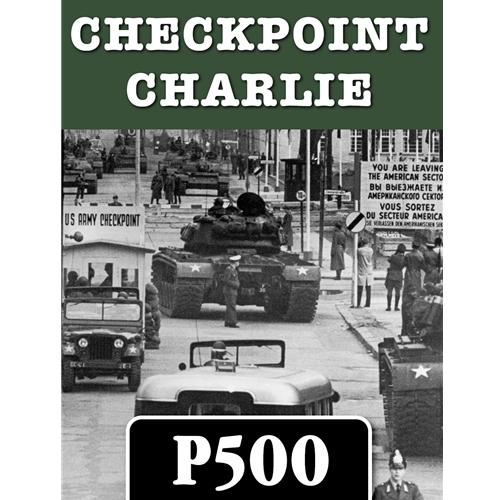
Checkpoint Charlie is a solitaire or cooperative game of British Secret Intelligence Service (SIS) espionage missions in Berlin in the early 1960s.
West Berlin is an isolated outpost of the Western Powers in the center of the German Democratic Republic (East Germany). East Berlin, on the other side of the Berlin Wall, is a base of operations for Soviet KGB agents and the Stasi secret police. This is a city of spies, a focal point of worldwide espionage in the growing Cold War. In this game, you send your assets (agents) on missions and use your influence and foresight to help them complete objectives before they are detected and compromised by KGB agents. As you play through these missions, you will:
- Ensure that an important defector gets safely out of the city.
- Make contact with a dissident Russian scientist on the other side of the Berlin Wall.
- Gather intelligence in East Berlin and return safely to the West
- Entrap a troublesome KGB agent with tempting intelligence.
- Sow distrust between KGB and Stasi agents.
- Identify a Soviet mole among your SIS agents and wait for them to reveal themselves.
Can you accomplish all of this in secret, as the very public events of the Cold War change the political landscape of Berlin itself?
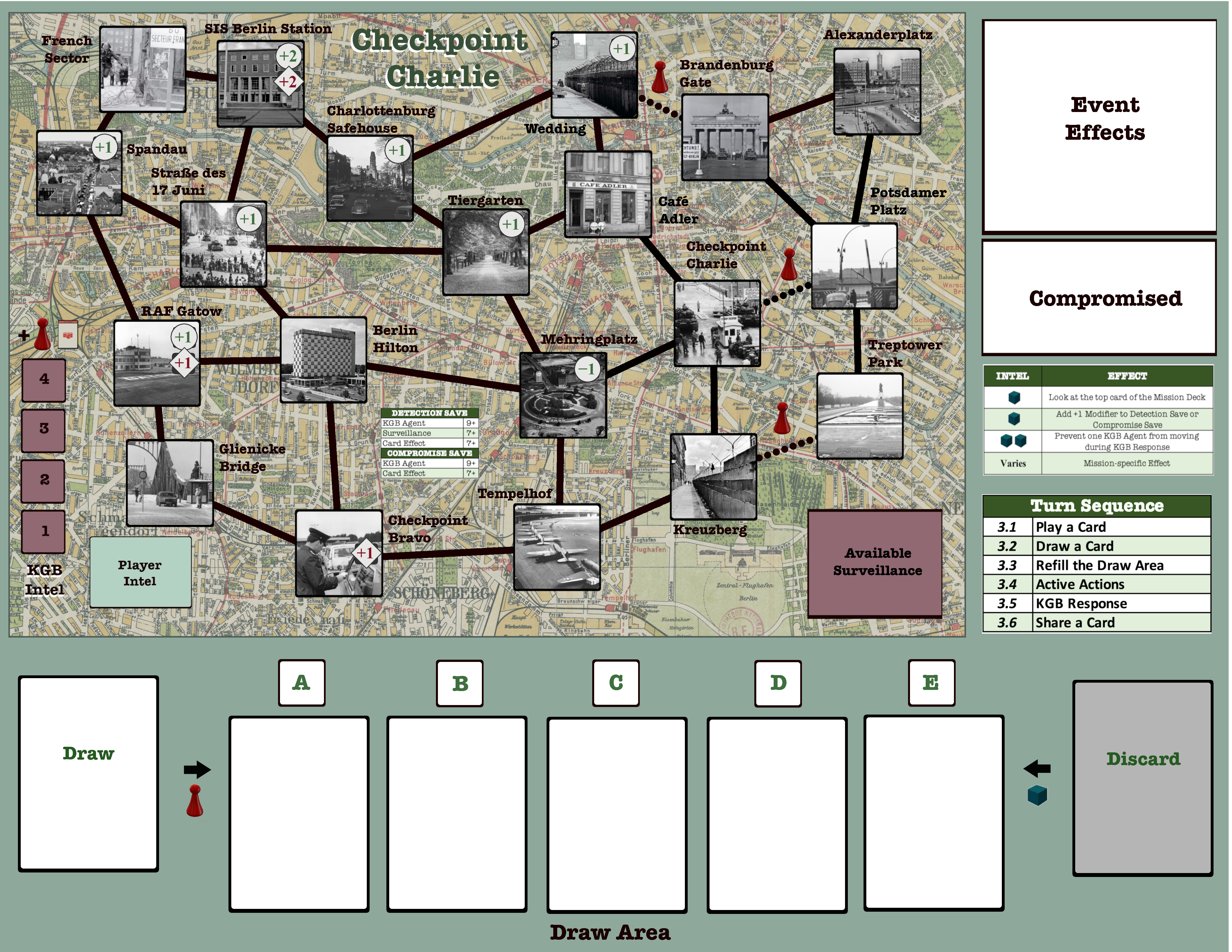
Checkpoint Charlie Game Board (prototype)
A CAT AND MOUSE GAME WHERE THE TABLES ARE SOMETIMES TURNED
This is a game about your assets staying one step ahead of the KGB and completing missions without being detected. Each mission starts with a different cast of assets and KGB agents, a set of items that may help complete the mission, and multiple historical events that can change the situation. Victory conditions are specific – getting an asset out of the city, making contact with a new source, or even crossing the Berlin Wall to gather important intelligence and returning without getting caught. There are no victory points or turn limits in Checkpoint Charlie, just objectives your assets must complete before they are compromised or overwhelmed by the growing web of KGB surveillance. The game map includes iconic locations like Checkpoint Charlie, Glienicke Bridge (the “Bridge of Spies”), and the notorious Berlin Hilton, each with unique game effects. You will manage a hand of cards that represent assets, items, and locations on the map. On your turn, you’ll play a card to influence the situation, and when you take a card from the Draw Area to refill your hand, every SIS asset and KGB agent in the city will move and take actions based on which card you chose. New Intel may appear on the map, locations may be placed under KGB surveillance, and Event cards may affect specific locations.
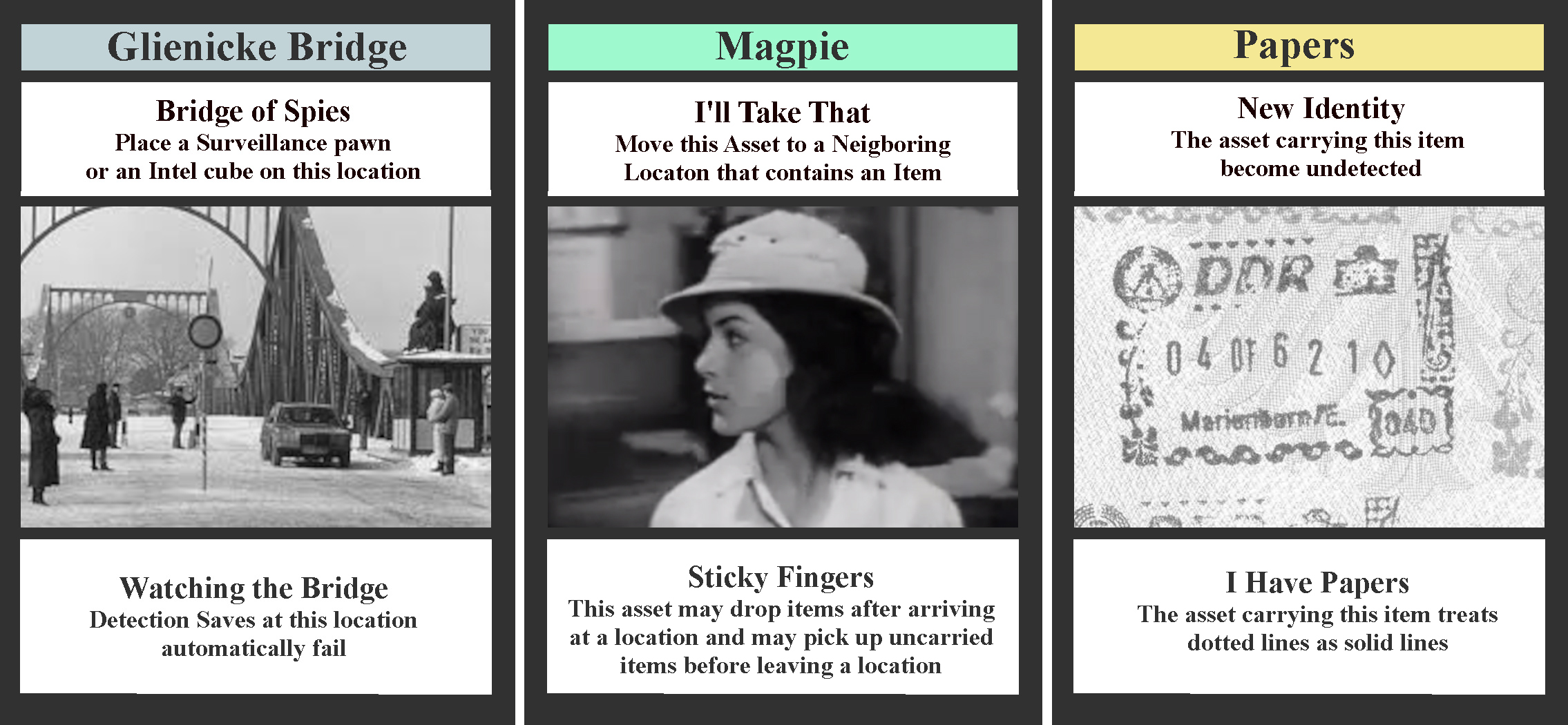
Prototype Location, Asset and Item Cards
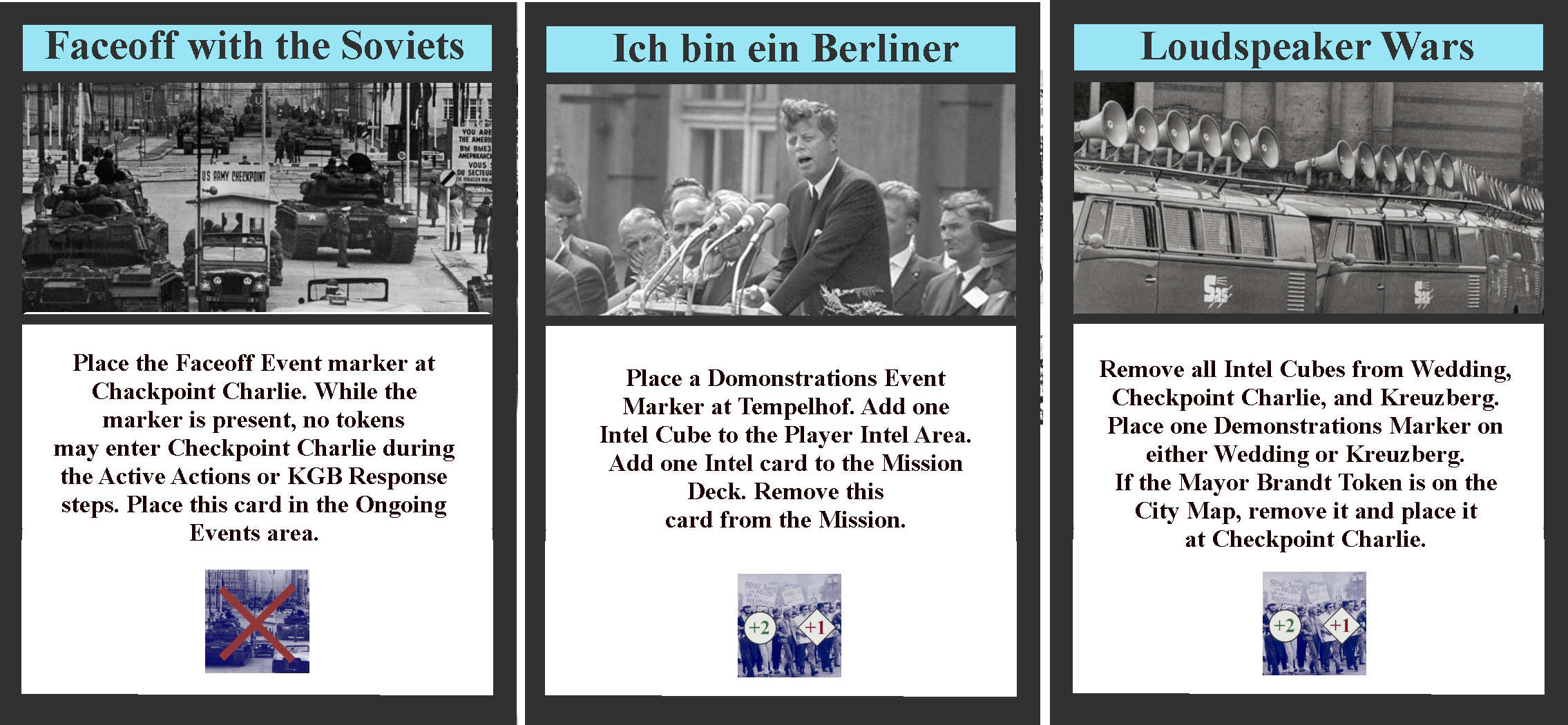
Prototype Event Cards
CARD DRAW MOVEMENT SYSTEM
In Checkpoint Charlie, you are not a field agent. You are a planner, a director monitoring the situation but limited in how much you can directly intervene. That sense of influencing the situation but often just having to watch as events unfold is created by the core mechanic of Checkpoint Charlie: the Draw Area below the map. This area contains five face-up location, asset, or item cards. Chits representing each of the tokens on the city map (your SIS assets and the KGB agents) are placed above each of the cards in the Draw Area. After playing a card from your hand, you will draw a card from either end of the Draw Area, and then the remaining four cards will shift left or right to fill the empty position before a new card is drawn to fill the row. In this way, every card in the Draw Area shifts one space whenever you draw a card. This is important because every token in Berlin then moves closer to the location, asset, or item on the card directly below their chit. In the example below, the cards have shifted and the empty spot has been filled. Now the Dentist will move to Mehringplatz. Jester will move one location closer to Checkpoint Charlie, and KGB Agent Svetlova will move toward the 1958 Rambler at RAF Gatow.
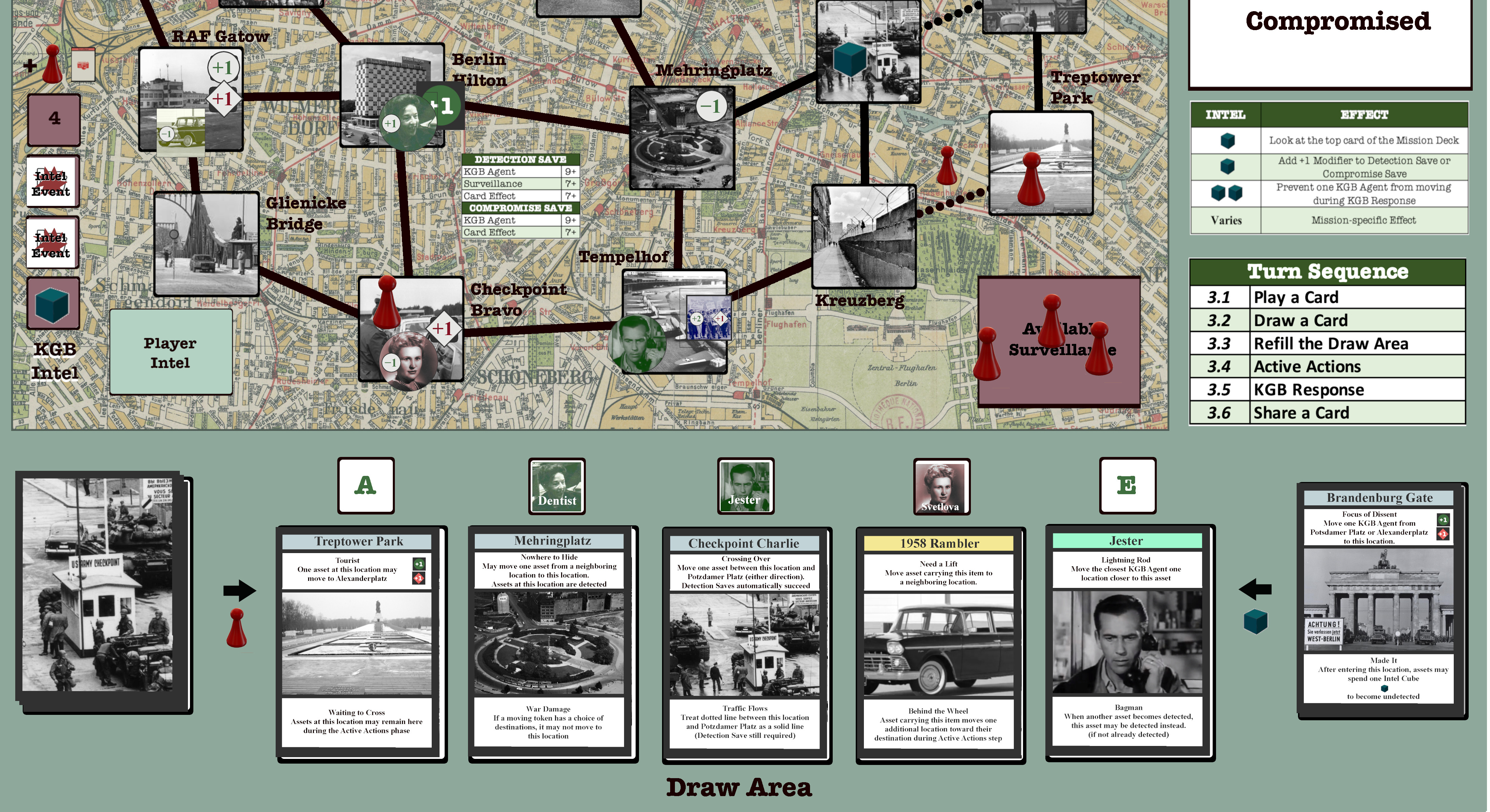
The Mission Deck, Draw Area with Active Chits, and the Discard (prototype artwork)
Choosing which of two cards to draw has a big impact on the progress of the mission, but you do have additional ways to help your agents succeed. The card you play before you draw can change where assets move. Tokens on the City Map (even KGB agents) often have a choice of paths to their destination, and you decide between them. You also decide how your assets interact with items on the map and you can spend Intel resources to look ahead at cards or influence the movement of KGB agents.
DETECTION AND COMPROMISE
INTEL
As a mission progresses, intel cubes will appear in locations around the map. These represent available intelligence pertinent to the mission (tangible intel, coded signals, or contact with local informants). These can be gathered by your assets, or by KGB Agents. You spend your gathered intel to look ahead in the draw deck or improve your chances of passing detection or compromise saves. If you have enough intel, you can even stop a KGB Agent dead in their tracks for a turn. This is all good, but when a KGB Agent gets to the intel before your assets, those intel cubes fill up a KGB Intel track that triggers detrimental effects specific to the mission. Perhaps another KGB Agent will appear, additional surveillance will become available, or a key asset or item will become detected.
PLACING SURVEILLANCE AND INTEL
The five face up cards in the Draw Area are also used to place intel and surveillance on the map as a mission progresses. The draw deck contains a number of Intel and Surveillance cards, with the number varying by mission. When drawing a card to fill the empty spot in the Draw Area, one of these cards may be drawn. When an Intel card is drawn, you discard it and place Intel on the location indicated by the rightmost Draw Area card (at the location shown on a card or in the current location of the asset or item on the card). When a Surveillance card is drawn, you discard it and place a Surveillance pawn on the location indicated by the leftmost card in the Draw Area. This represents the KGB taking an interest in that location and committing surveillance resources, sometimes at the expense of surveillance in other locations. Intel is essentially unlimited, but surveillance is limited by the available Surveillance pawns specified for the mission, representing the current KGB commitment to surveillance in the city. As a mission progresses, KGB surveillance tends to increase as suspicion increases (due to Event cards and the KGB agents gathering intel and filling up the KGB Intel track). Missions that go on too long tend to fail. Despite the perception of intelligence operations as patient, deliberate exercises, in the contained chaos of Berlin, fortune still favors the bold.
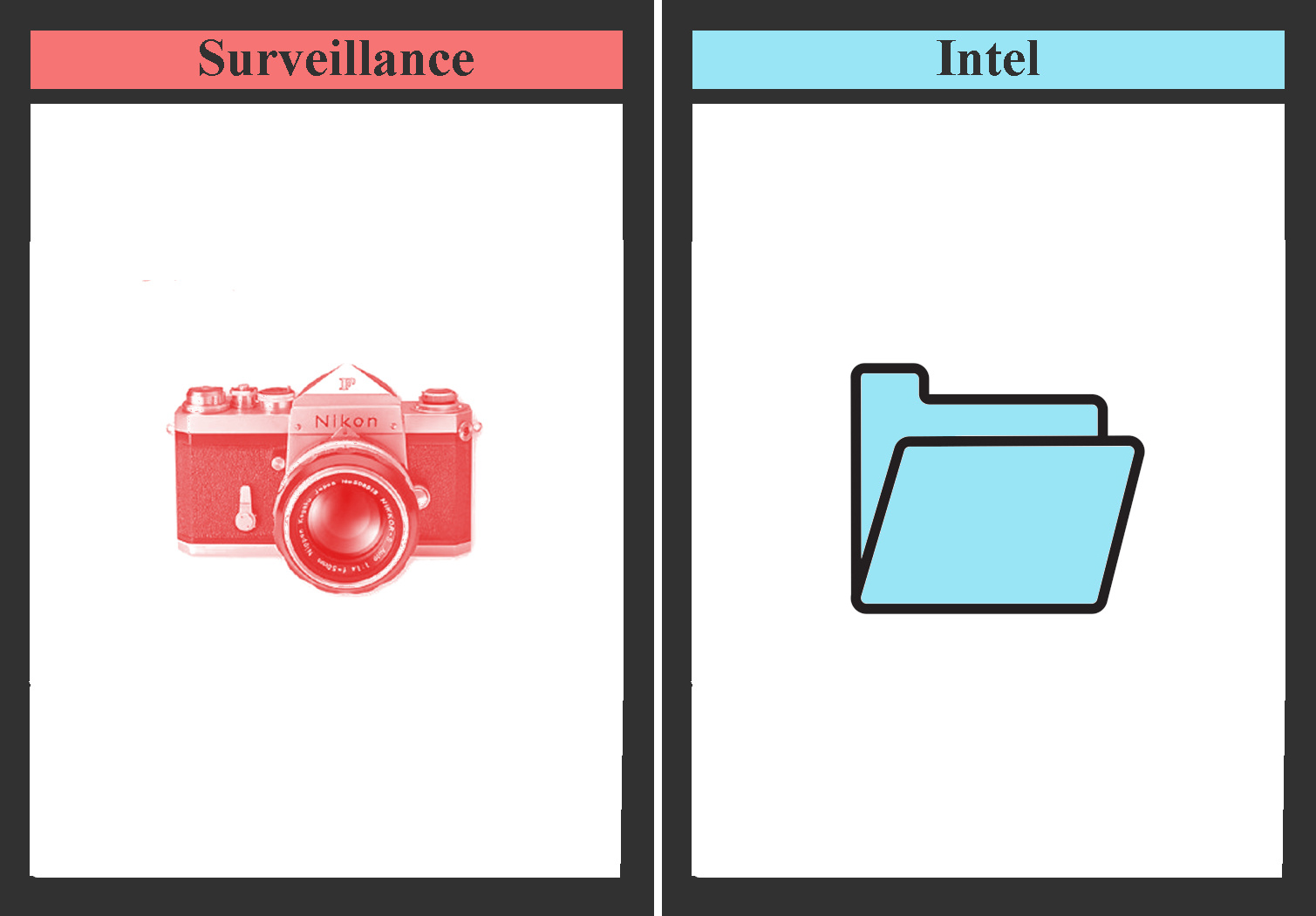
Prototype Surveillance and Intel Cards
ITEMS
Items represent the intelligence artifacts and traditional spy gear used by the intelligence community. A typical mission includes a few items, one of which is likely crucial to the success of the mission. These could be instructions that must be delivered to a potential source, a key piece of intelligence that must be retrieved and brought to safety, or even a Luger 9mm pistol that can remove a particularly troublesome KGB Agent. A mission typically fails if a key item is compromised. The other items, those not integral to the mission, can help your assets in particular ways. The disguise kit can help them move through surveillance. Papers allow them to cross into East Berlin. The 1958 Rambler can speed them toward their destination at the cost of some added attention. A spy radio can gather intel from East Berlin without crossing the wall. And the nugget, a piece of juicy manufactured intelligence, can act as an invaluable decoy or bait in a trap. As a last resort when detected and being pursued, a dropped item may distract a KGB agent just long enough for your assets to complete the mission.
CARD EFFECTS
The Draw Area, and your hand of cards, will contain location, asset and item cards. The draw deck also contains surveillance, intel and event cards, but these are resolved and discarded as soon as they are drawn and never reach the Draw Area or your hand. Each location, asset and item card specifies two different effects. The top effect happens when you play the card at the start of your turn. This typically affects the location, asset or item on the card, or sometimes an asset at or near a location or carrying the item. The effect on the bottom of each card is the active effect and applies as long as that card is showing in the Draw Area. These active effects can significantly impact the movement of tokens on the map and the chances of being detected. As one example, the Berlin Hilton active card effect is the Honey Trap – assets at this location cannot leave except as the result of played card effects. Not all active effects are bad, however. When the Charlottenburg Safehouse card is showing, all detection saves in that location automatically pass. That’s what safehouses are for.
PLAY SINGLE MISSIONS OR A COMPLETE CAMPAIGN
Checkpoint Charlie includes twelve missions of varying difficulty that can be played in any order. The game also includes a Campaign mode in which you play through eight missions during your assignment as a Case Officer in Berlin. Intel gathered in one mission may carry over to the next, and you’ll experience most of the historical events in the game during your tour of duty. Success or failure on each mission may affect which missions you’re assigned in the future. If you make contact with the dissident scientist in one mission, you’ll eventually direct a mission to extract him to the West. If you pick up intelligence from the dead drop that tips you off to a mole among your agents, you’ll run a mission to reveal them. Your pool of assets is also limited in Campaign Mode, and if one of them is compromised on a mission, it may be risky to assign them to a future mission, or they may not be available at all. When your final mission is over, you’ll be rated on your record of success. Will you be remembered as a legend in the service or a possible double agent?
COOPERATIVE MULTI-PLAYER OPTIONS
Up to three players can work together as a group of Case Officers to successfully complete a mission. Players have their own hand of cards but also contribute cards to a shared hand available to all players, representing the resources shared between them. As an added challenge, players can use Secure Communication rules that impose restrictions on their interactions, only allowing open conversations between players when one of them spends a Meeting card. Spymasters directing SIS assets in Berlin have to be very careful when and where they meet to discuss a mission. Meeting cards represent the limited opportunities for such covert or secured meetings, whether they take place in a soundproofed Faraday cage at SIS Berlin Station or a secluded park bench deep in the Tiergarten.
Players: 1-3 (Solitaire or Cooperative)
Age: 14+
Playing Time: 30-45 minutes per Mission. Campaign Mode (8 missions) takes 240 minutes.
Components:
- One 17” x 22” Mounted Game Board
- One Countersheet
- 10 Red Surveillance Pawns
- 20 Blue Intel Cubes
- 34 Location, Asset and Item Cards
- 15 Event Cards
- 22 Surveillance, Intel and Meeting Cards
- One Rule Book
- One Mission Book
- One 10-sided Die

Comentarios