Players will struggle to create political legitimacy for themselves while contending with both Italian rivals and external great powers intent on conquest of their own objectives in Italy (France, Spain, the Holy Roman Empire, and the Ottoman Empire). For those who have played other series games, much will be familiar mechanically, but there are many new concepts and mechanics to enjoy, including experimenting with different government types, managing local sentiment, and gathering precious florins to pay for mercenaries and their fickle condottieri captains.Furthermore, players will be faced with the possibility of collective defeat to the great powers. Players will individually pursue Virtù Points, drawing on Machiavelli’s famously pliable conception of political ability and military strength, while at the same time striving to avoid collective defeat by loss of Italian Virtù. Dwindling Italian Virtù embodies Machiavelli’s abiding fear of great power domination of Italy. Players will each attempt to win without Italy falling into the subjection that was historically its fate, and should they fail to prevent that, the game ascribes blame to the specific players viewed as the scourge of Italy and the new lapdog of the great powers. Can you thread the needle between your Italian rivals’ ambitions and the threat posed by the great powers of Europe?
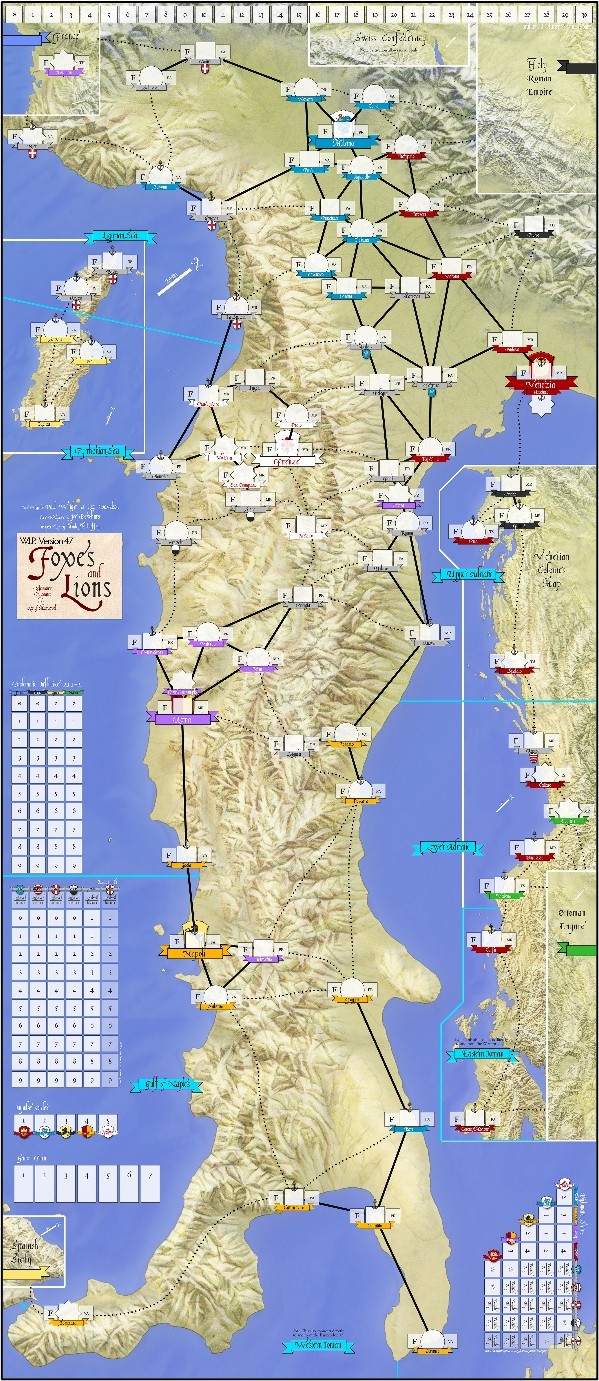
Prototype game map (not final art)
Concepts and Features New to the Series
- Political traditions—These are the governments (current and past) that define the political character of any given space in the game (featuring merchant republics, feudal aristocracies, princedoms, theocracies, tribute states, and vassals). In keeping with Machiavelli’s respect for founders of institutions, lawgiving will be an available action that permits you to attempt to alter governments in your dominion. Each space under your control may have a very different political arrangement, which affects its prosperity, unit construction capability, and many other things. Your central government (that of your capital) may also change over time.
- Sentiment—This captures the current attitude of the local population to the government overseeing it. The scale of sentiment reflects Machiavelli’s own terminology, ranging from “Hated” to “Feared,” to “Feared and Loved” (the latter an ideal Machiavelli thought hard to achieve, opting instead for being “Feared” whenever a choice between fear and love was unavoidable).
- New unit types—Regulars are split into citizen militia and feudal levies, alongside a more detailed look at mercenaries (with elite variants including the Swiss reisläufer and the Imperial landsknechte).
- Condottieri captains—Twenty of the colorful, talented, and sometimes treacherous mercenary captains of the era will be available to players in competitive blind bidding for their services, with each captain reflecting unique battlefield abilities, vulnerabilities, and other surprising game impacts. Captains are essential to success in the game, and if not properly paid and retained, will go up for auction again; they may even be suborned and taken from you by nefarious rival actions. Among the captains are the infamous Cesare Borgia, Fabrizio Colonna, Giovanni delle Bande Nere, and “El Gran Capitán” himself, Gonzalo Fernández de Córdoba.
- Money economy—Alongside the high-level political capital of command points (CP) already familiar to CDG players, Foxes and Lions features the cold, hard cash that mercenaries and dominions crave. Florins are collected by a trade action connected to the prosperity of the various governments in one’s dominion. The florin economy will be necessary not only to pay or bribe mercenaries and captains, but also for espionage, government maintenance, and more. Player treasuries are hidden behind a screen, so no one is ever quite sure of a rival’s wealth. Should you run out of florins for a required or desired expenditure, the banks will be available to lend to you at exorbitant interest rates, and failure to repay may cost you dearly.
- Espionage available from turn one—Nefarious measures are available to players from the outset of the game, including familiar operations from Virgin Queen like Gain Intel and Assassination, now supplemented with Pacification, Foment Rebellion, Sabotage Fortifications, and Suborning others’ employed condottieri to your cause.
- New patronage systems and figures—For those familiar with Virgin Queen, patronage now features three tracks (artists, scientists, and humanists) with 10 figures of each type. Patronage targets may now be selected rather than randomly drawn, and each affords unique game effects. Among the 30 patronage subjects are figures such as Michelangelo, Da Vinci, Botticelli, Copernicus, Pacioli, Paracelsus, Machiavelli, Manutius, and even a prying poet-courtesan, Tullia d’Aragona.
- New ruler dynamics—Each player will have an often-volatile lineup of rulers who will transition based on circumstances in the game (26 rulers in total across five player powers). In the case of the Papal States, a conclave procedure involving all five players will determine the next pope whenever the current pope dies (however mysteriously).
- Variable impulse order—Players may bid their florins to change the impulse order for a given turn, creating dynamic opportunities for surprising your enemies—or lying in deadly wait for them.
- More opportunities to declare war mid-action phase—No game about Machiavelli’s era would be complete without the temptations and risks of back-stabbing rivals, even erstwhile allies, including in the middle of a turn. Great coalitions (like the historical “Holy League”) may form, but no alliance is ever truly safe.
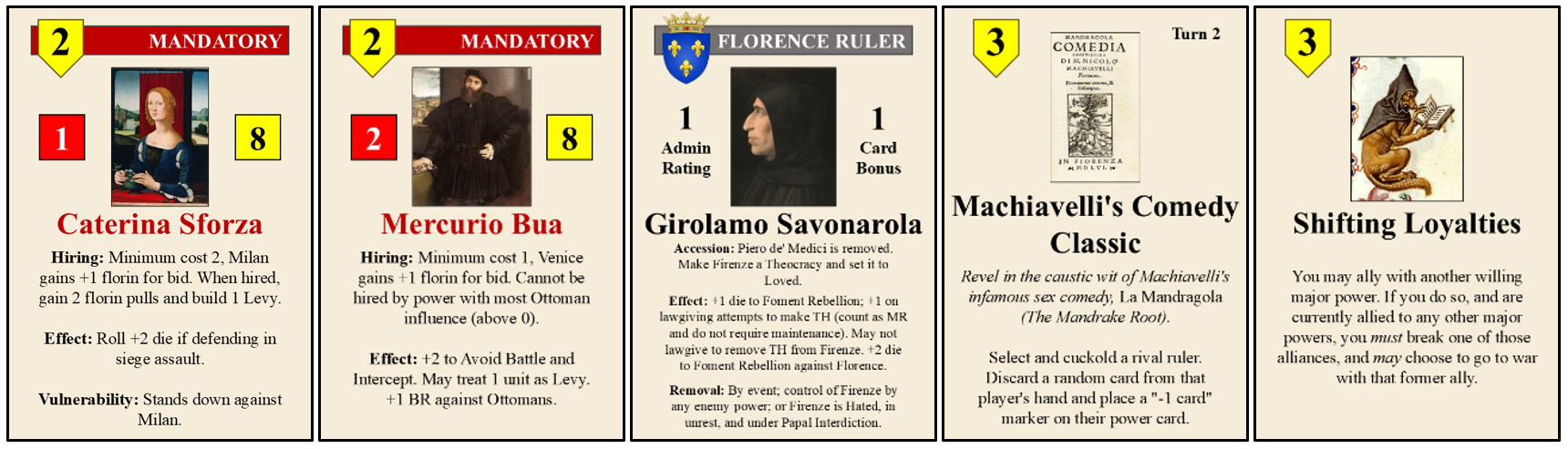
Prototype captain, ruler, and ruler cards (not final art)
Player Powers and Non-Player Great Powers
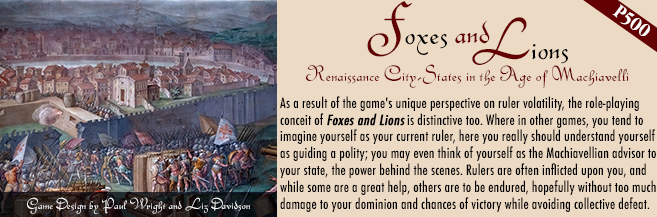
As a result of the game’s unique perspective on ruler volatility, the role-playing conceit of Foxes and Lions is distinctive too. Where in other games, you tend to imagine yourself as your current ruler, here you really should understand yourself as guiding a polity; you may even think of yourself as the Machiavellian advisor to your state, the power behind the scenes. Rulers are often inflicted upon you, and while some are a great help, others are to be endured, hopefully without too much damage to your dominion and chances of victory while avoiding collective defeat. The Renaissance state is a tortuous management puzzle, as you contend not only with rivals, but also with the volatility of your own populace.
The playable powers are the five Italian factions identified by Machiavelli as crucial to the era:
- The Republic of Florence, the culturally ascendant hometown of Machiavelli that at game start seems about to throw off the shackles of Medici rule and replace it with the apocalyptic preachings and theocracy of Friar Savonarola.
- The Most Serene Republic of Venice, a merchant oligarchy and the economic powerhouse of the Mediterranean, rightly concerned about losing its overseas trade empire to the Ottomans and others; its colonies in the Balkans loom large in the game.
- The Duchy of Milan, lorded over by descendants of the former condottiere captain, Francesco Sforza, and constantly scrambling for ducal legitimacy.
- The Kingdom of Naples, a more traditional feudal monarchy that is the continual object of dynastic disputes between France and Spain; King Charles VIII of France is fixated on his claims to Naples at game start.
- The Papal States, a theocratic princedom led first by the Borgia Pope Alexander VI and later by the Borgias’ hated rival, the “warrior pope” Julius II, among other pontiffs featured, including the Medici popes, Leo X and Clement VII.
The plans of players will inevitably be impacted by the non-player great powers in the game, whom players will try (and often fail) to manipulate to their own ends. These include:
- The Ottoman Empire, presided over initially by Bayezid II and then his successors, including sea captains out to pirate Italian (especially Venetian) holdings.
- The Kingdom of France, led at first by Charles VIII, then Louis XII and Francis I; obsessed with their claim on Naples (and Milan too).
- The Kingdom of Spain, led by the House of Trastámara, related to Naples’s own royalty and nobility.
- The Holy Roman Empire, led first by Maximilian I, then later Charles V, one of the most powerful monarchs Europe had ever seen, who will unite Spain and the Empire to Italy’s great peril, culminating in the 1527 Sack of Rome.
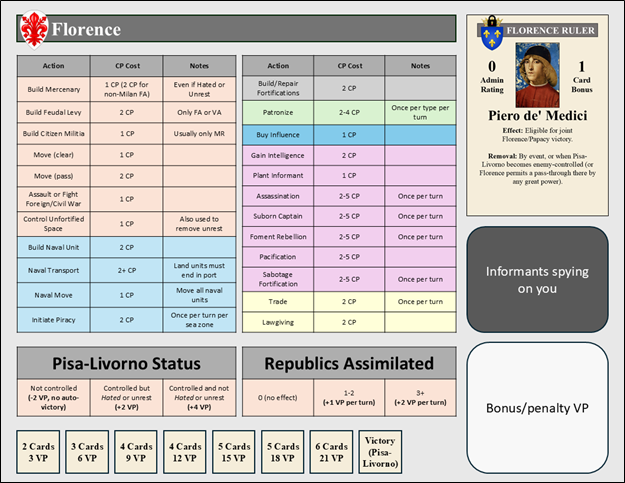
Prototype power card (not final art)
Historical Background of the Campaign Scenario
In The Prince, Machiavelli famously said that princes and other states must not rely on God to “do everything” to save them from the mounting threats of great power adversaries from outside Italy—or from one another. In 1492, Italy’s delicate “balance of power” under Lorenzo il Magnifico has been shattered with his passing. Only two years later, as the full game begins, Lorenzo’s son Piero has proven a disastrous inheritor of his father’s power and is on the verge of being ousted from Florence, with the threat of a new theocratic republic to emerge under the fiery Friar Savonarola. Venice watches with great concern as its Mediterranean colonies are whittled away by the Ottomans, while Milan looks in every direction for great power allies (or threatening great power conquerors). Charles VIII of France looms large in this moment, pressing his claims to the Kingdom of Naples. Naples continues to deal with these dynastic tensions between the houses of Valois and Trastámara, as well as trying to keep a grip on its Italian vassals. The Papacy seeks to increase their secular power and expand their dominion, all while Pope Alexander VI contends with the challenge to orthodoxy represented by Savonarola. Which prince or state will find a path to security and autonomy? Which will seek hegemony in Italy and unite it as Machiavelli entertained? Or will Italy, as Machiavelli feared and saw come to pass, be debased and crushed under the heels of the great powers?
Components:
- One Mounted Map
- 173 Playing Cards
- Five Power Cards
- Five Player Screens
- Six Supporting Charts
- Six Countersheets
- One Rulebook
- One Scenario Book
- Ten 6-sided dice
- 30 Leader Stands
- One Draw Bag
- A 3″ Box
Players: 5 (with scenarios for smaller player counts)
Timescale 4-5 years per turn (7 total turns in full game)
Game Designers: Paul Wright and Liz Davidson
Game Developer: Joe Dewhurst
Series Designer: Ed Beach

Comentarios