
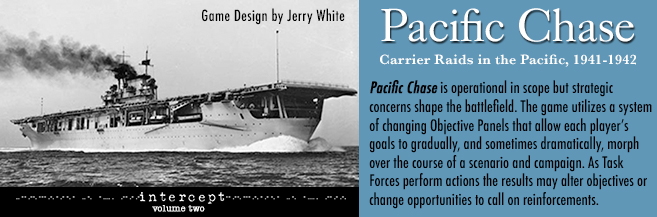
The game is operational in scope, but strategic concerns shape the battlefield. The game utilizes a system of changing Objective Panels that allow each player’s goals to gradually, and sometimes dramatically, morph over the course of a scenario and campaign. As Task Forces perform actions, the results may alter objectives or change opportunities to call on reinforcements. For the Japanese player, the construction of a robust defense perimeter of island bases governs their set of objectives, while the U.S. player will be keen to interrupt that strategy without risking a disastrous loss of naval assets. The Op Panel system allows players to make key choices operationally while the game maintains broad historical parameters strategically.
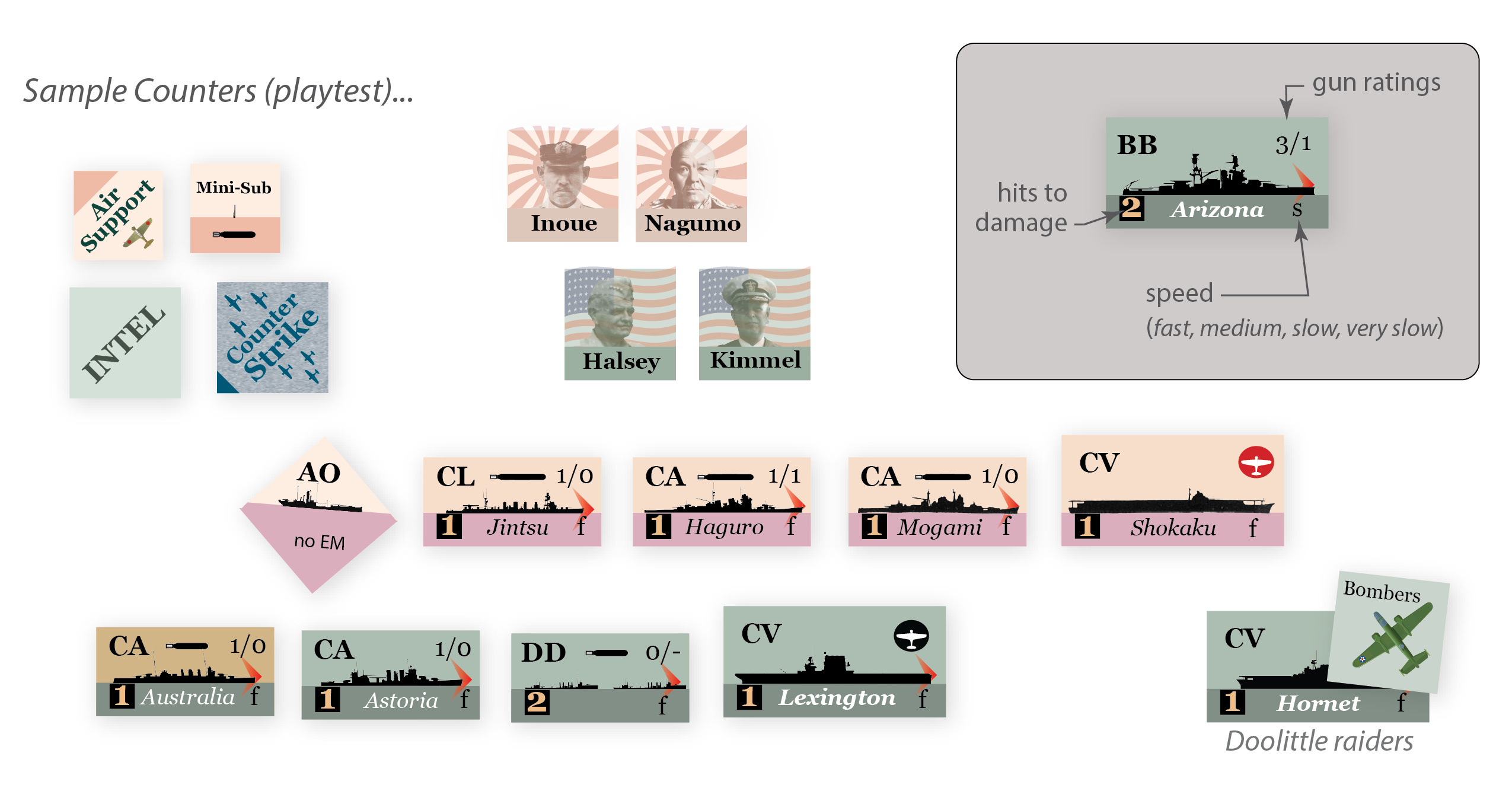
Counters (subject to change)
The game chronicles Imperial Japan’s outward push to Wake atoll, Midway, the Aleutians, and especially the Solomons and New Guinea. The Americans sally forth with what assets they still have, performing small and sometimes substantial raids to distract or hamper Japanese operations, or mount an outright stand. Scenarios encompass the raid on Pearl Harbor that opened hostilities and those that followed: operations to capture Wake, Rabaul, Port Moresby, Midway, and the Aleutians, as well as the summer initiative by the United States and its Allies to secure an airfield in Guadalcanal. There are options and decisions to make. The Japanese player might prefer to skip the raid on Pearl Harbor and focus their energy elsewhere, affording their adversary the opportunity to utilize their impressive fleet of battleships. Or perhaps they will choose to hunt American aircraft carriers, ignoring the battleships. What will the American player do in reply?
The game is organized into scenarios large and small, for two players and for solitaire as either the Imperial Japanese or the United States player. Scenarios cover one or two months of operations and put into play a vast stretch of territory from Hawai’i to the Japanese Home Islands, the Aleutians to the tip of Australia. Several mini-map scenarios focus on a single action, such as the invasion of Wake for example, the Battle of Savo Island, or Battle of the Coral Sea, and are played without Op Panels and on an 8.5” x 11” inset map (six inset maps are included in the game). At the other extreme, the campaign strings together operations and uses all twenty-four Op Panels, spanning the crucial first nine months of the Pacific War, and offers players the entire map. The game features battleships, aircraft carriers, cruisers, troop ships, and destroyer squadrons. Air bases are vital, as Imperial Japan strives to build a wall to keep the growing American juggernaut at a distance. Operations during the Campaign Game and stand-alone historical scenarios each take 1-2 hours to play.
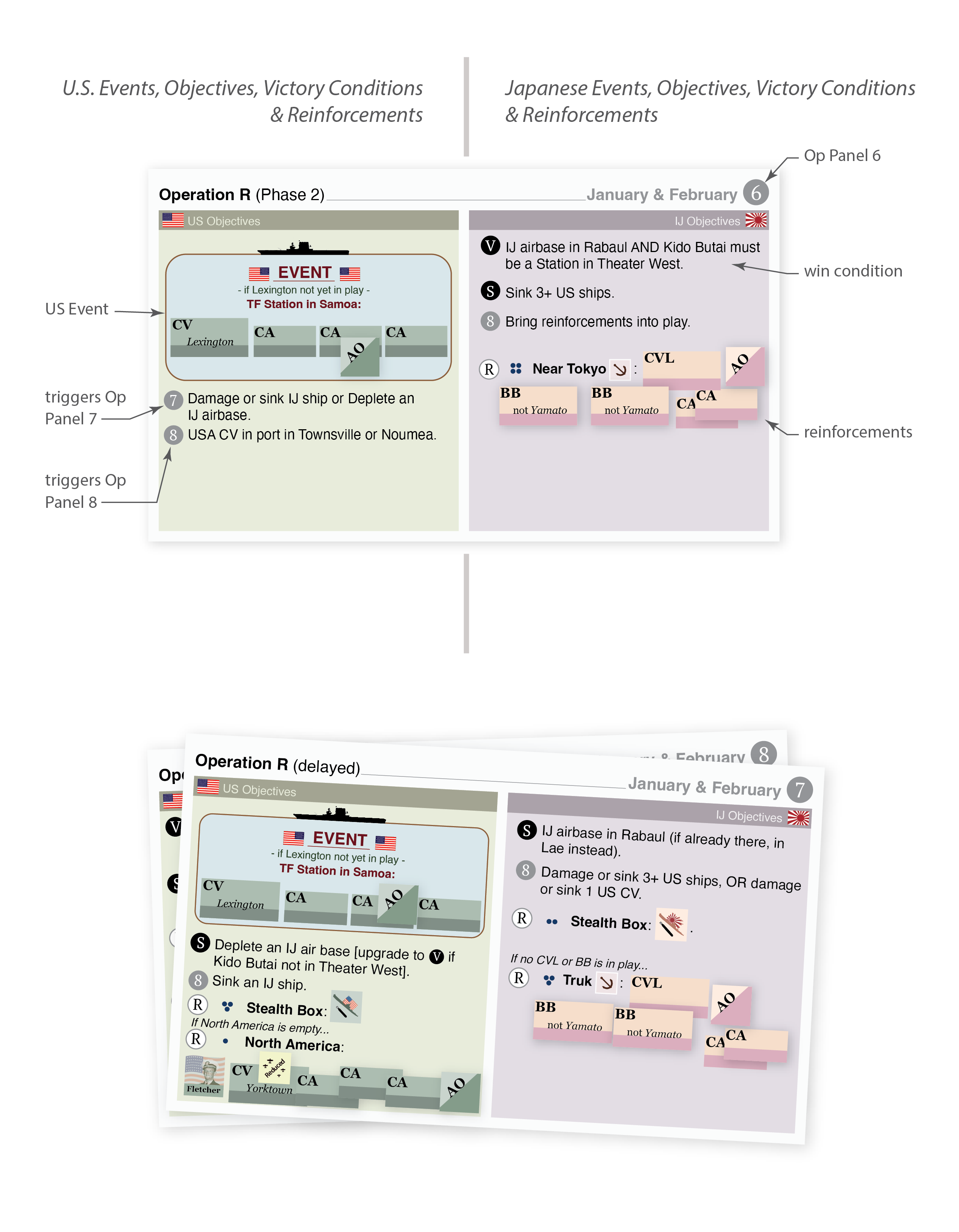
OP Panels (subject to change)
Will the Japanese player do what the Kido Butai never managed, trap and annihilate U.S. carriers? Or will Admiral Nimitz manage to elude that fate while keeping the Imperial Japanese Navy from realizing its strategic goals?
Imagine Admiral Nagumo aboard the aircraft carrier Akagi as its task force steams for Midway in the first week of June 1942. With orders to raid the U.S. airbase in preparation for an invasion, he dare not break radio silence. This means the Admiral of the Combined Fleet does not know the Akagi’s whereabouts, only its point of embarkation and its intended destination. More importantly, he can’t know the precise location of the American aircraft carriers either. Last reported in Hawai’i, it is hoped the attack on the airbase will draw them out. Meanwhile, Admiral Nimitz has information placing the Japanese task force on its way to Midway and sends a U.S. carrier force to intercept. Once that task force exits Pearl Harbor, adhering to a protocol of radio silence too, their exact location will remain a mystery. Only when one task force makes contact with the enemy, and aircraft launch to strike, will information be forthcoming. Only then will the picture clarify.
In this game system, each task force is represented either as a point or a line, a station or a trajectory. As a point, the task force’s location is fairly well-known, but as a line it only presents fuzzy information. Its location is somewhere between the ends of the line.
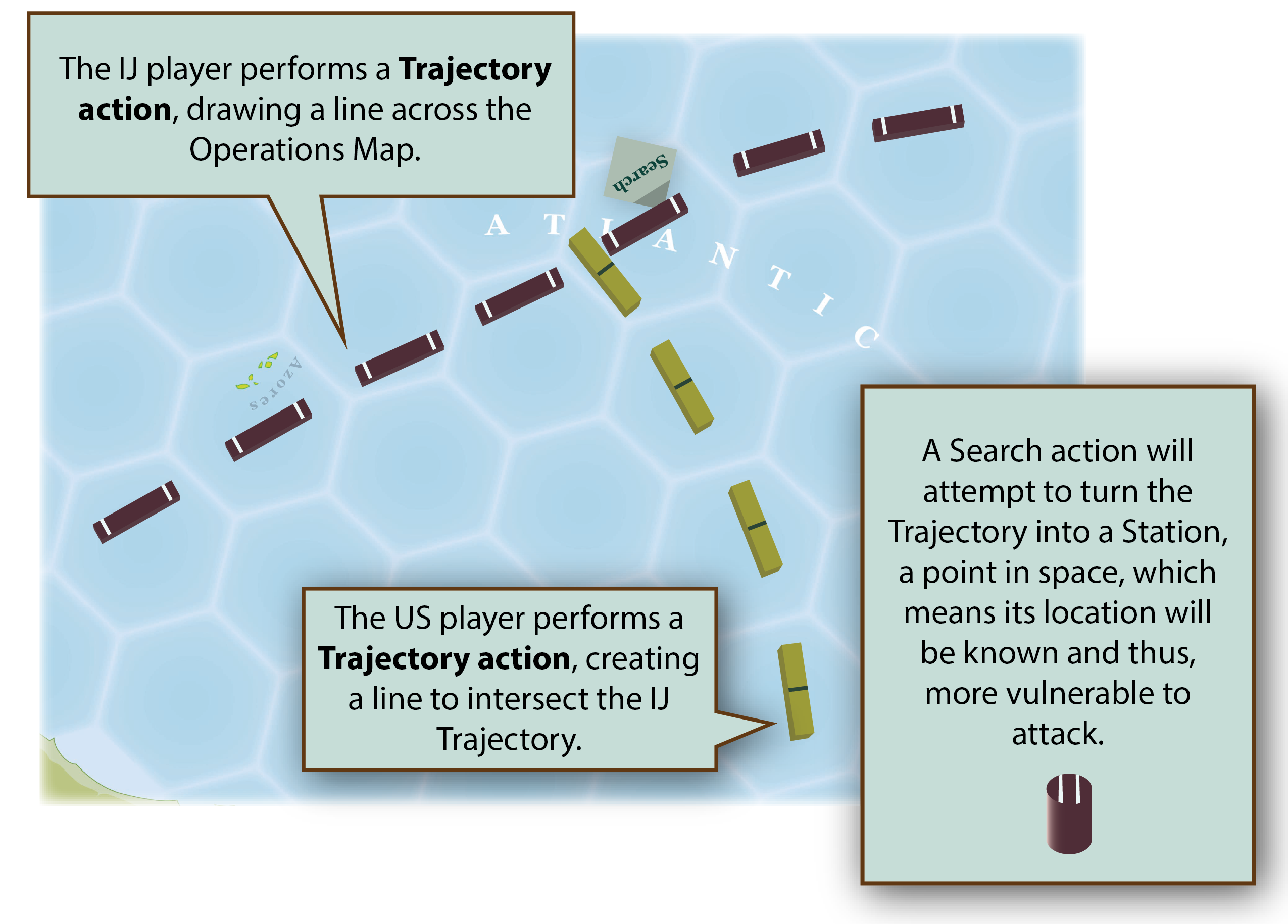
Trajectories (work in progress)
As a line, a task force is harder to bring to battle. A trajectory indicates a probable course. The ships that comprise that task force are kept off map on a Task Force Display, and they are understood to be in a group somewhere between the two ends of the trajectory. To bring those ships into port, or to battle, the trajectory must be reduced to a point.
There are no turns in Pacific Chase. While a player has the Initiative, they activate task forces to perform actions and continue doing so until they lose the Initiative. The game swings back and forth until the scenario or operation is complete, each player striving to bring the enemy to battle under advantageous circumstances. Typical of the historical events depicted by the game, battles tend to be fleeting and short, interspersed with searches, evasive maneuvers, more air attacks, shore bombardments, perhaps a surface engagement, invasions, and attempts to break away to safety.
Players conduct actions to “clarify” lines into points, thereby determining where battles happen or ships slip into port.

Comentarios